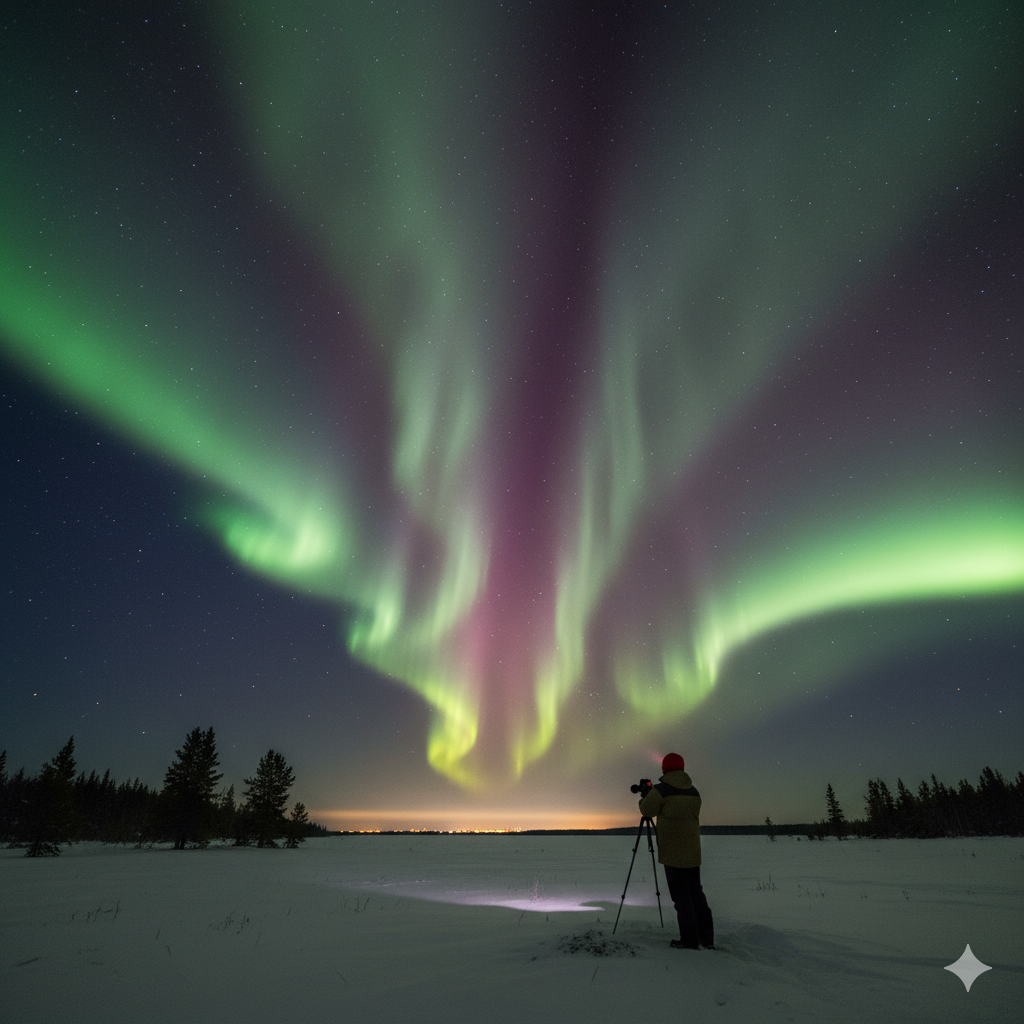
Understanding the aurora is the first step in hunting for it. The Northern Lights, or Aurora Borealis, are a direct result of the sun’s intense activity interacting with Earth’s magnetic field and atmosphere. This interaction creates the vibrant colors and dancing curtains of light.
The Aurora Borealis, a celestial light show of unparalleled beauty, is one of nature’s most sought-after spectacles. When a geomagnetic storm erupts, the question on everyone’s mind shifts from planning a distant Arctic trip to a much more immediate and exciting query: “Can I see the Northern Lights tonight?” In 2025, with the sun’s activity nearing its predicted Solar Maximum, the chances of seeing this dazzling phenomenon from unexpected, lower latitudes are higher than they have been in years. This highly active period increases both the frequency and intensity of major geomagnetic events, making tonight’s outlook particularly promising.
This comprehensive guide serves as your definitive resource for tracking, planning, and successfully viewing the Aurora Borealis, whether you’re deep within the Arctic Circle or hoping for a glimpse from the lower continental regions. We will delve into the science, the real-time forecasts, the best viewing techniques, and what this current, highly active solar cycle means for your aurora chase.
The Science Behind the Spectacle: Why the Aurora Is Visible Tonight
Getty Images
The Coronal Mass Ejection (CME) and the Kp Index
The core of an aurora viewing opportunity is a powerful solar event, primarily a Coronal Mass Ejection (CME). A CME is a massive burst of solar wind, plasma, and magnetic field that is released from the sun’s corona. When one of these ejections is directed at Earth, it takes between one to four days for the charged particles to travel the 93 million miles across space and collide with our planet’s magnetosphere.
The intensity of this collision is measured by the Kp-index, the planetary K-index. This index ranges from 0 (very low activity) to 9 (severe geomagnetic storm). The Kp-index is the single most important number for predicting how far south the aurora will be visible:
- Kp 0-4 (Low/Minor): Lights are typically confined to the high Arctic regions (Iceland, Norway, Alaska, Canada).
- Kp 5 (G1 – Minor Storm): The aurora oval expands, often becoming visible in parts of Scotland, the northern United States (Minnesota, Michigan, Maine), and southern Canada.
- Kp 6-7 (G2 – Moderate to G3 – Strong Storm): Lights move further south, potentially visible from the northern half of the continental US (e.g., Colorado, New York, Washington state, typically 50-degree geomagnetic latitude).
- Kp 8-9 (G4 – Severe to G5 – Extreme Storm): This is the ultimate event, allowing the aurora to be seen from remarkably low latitudes, sometimes as far south as Alabama, Northern California, or Southern Texas during the most severe storms.
The current Solar Maximum is the reason for the high chance of a spectacular show, with the sun producing more X-class flares and CMEs, significantly increasing the likelihood of a Kp 7 or higher event that expands the aurora oval dramatically.
📡 Tracking the Northern Lights Tonight: Real-Time Forecasts
Seeing the aurora is a blend of science, planning, and patience. You can’t just wait for the sky to light up; you need to track the current and projected space weather.
Real-Time Geomagnetic Forecasts
The key to a successful aurora hunt is constantly monitoring the short-term forecasts from authoritative sources.
- NOAA/SWPC 3-Day Geomagnetic Forecast: The National Oceanic and Atmospheric Administration’s (NOAA) Space Weather Prediction Center (SWPC) is the global authority. Their 3-day forecast is essential, providing the expected Kp-index for upcoming 3-hour blocks. If the forecast shows a Kp of 5 or higher, you should be on high alert. You can check the official Kp-index forecast for planning your viewing window.
- Aurora Oval Maps: NOAA and other meteorological institutes publish an “Aurora Oval” map, which shows a 30-minute prediction of the aurora’s location and intensity. The green oval represents the typical location; a higher Kp index causes the oval to expand equatorward (southward). For the most accurate, minute-by-minute updates on the space weather conditions, always check the official real-time geomagnetic activity map.
- Local Weather and Cloud Cover: A high Kp index means nothing if your sky is blocked by clouds. Always check your local cloud cover forecast. The rule of thumb: Clear Skies > High Kp. A lower Kp under a clear sky is a better viewing opportunity than a high Kp under thick clouds.
Tonight’s High-Alert Window (Based on Current 2025 Data)
Based on the highly active solar environment confirmed by recent NOAA reports, a G4 (Severe) or G3 (Strong) geomagnetic storm is highly likely to be in effect or developing tonight, November 12, 2025.
| Time (Local/Approximate) | Forecast Kp-Index | Geomagnetic Storm Level | Expected Visibility (Look Northward) |
| 8:00 PM – 10:00 PM | Kp 6-7 | Strong (G3) | Northern US States (Washington, Montana, North Dakota) |
| 10:00 PM – 2:00 AM | Kp 7-8 | Severe (G4) | Mid-US States (PA, IL, CO, Northern CA) |
| 2:00 AM – 4:00 AM | Kp 5-6 | Moderate (G2) | US-Canada Border States |
The best viewing window for the brightest, most spectacular displays is typically around local midnight (10:00 PM to 2:00 AM). Be in your viewing spot early!
🗺️ Where to See the Northern Lights Tonight: Optimal Viewing Strategy
While the location is determined by the Kp-index, your actual viewing success depends on your on-the-ground strategy.
1. Maximize Your Northern View
- The Northern Horizon: Regardless of your latitude, the aurora will always appear on the northern horizon. Position yourself with a clear, unobstructed view facing north. This means finding a spot away from hills, forests, or buildings that block your line of sight.
- The Darkness Factor: Light pollution is your biggest enemy. Even a moderate aurora can be washed out by city lights. Drive at least 30-60 minutes outside of any major metropolitan area. Look for a designated dark sky location or a spot on a hill that offers a wide, open view.
- Allow Eye Adjustment: Give your eyes at least 30 minutes in the total darkness to fully adjust your night vision. Once adjusted, you will be able to see fainter, whiter auroras that might be invisible when you first step outside.
2. Preparing for the Cold (The Patience Factor)
Aurora viewing means standing outside in the cold for hours. Dress in multiple warm layers—more than you think you need—including insulated boots, hats, and gloves. A thermos of hot tea or coffee is a must. If you intend to capture and share your experience online, make sure you have a robust SEO-optimized content strategy ready for your posts, as you’ll have plenty of time to plan your narrative while waiting.
📸 Capturing the Magic: Photography Tips for the Aurora Borealis
The camera often sees the aurora better than the human eye, capturing colors and details that are too faint for us to perceive in the dark. A camera setup is an essential tool for an aurora hunter. Successfully capturing the lights can be a key step in building website authority in the space-photography niche.
Essential Gear and Settings:
| Gear Essential | Recommended Settings (DSLR/Mirrorless) | Notes |
| Sturdy Tripod | Mode: Manual (M) | Essential for long exposures. |
| Wide-Angle Lens (f/2.8 or wider) | Focus: Manual, set to Infinity ($\infty$) | Crucial for sharpness; turn off Auto-Focus. |
| Extra Batteries | Aperture (f-stop): $f/2.8$ (or lowest number) | Widest opening lets in the most light. |
| Manual Control Camera | ISO: Start at $ISO 1600$ to $3200$ | Adjust down if the aurora is very bright. |
| Remote Shutter | Shutter Speed: $4$ to $15$ seconds | Shorter (4s) for fast-moving lights; Longer (15s) for faint glow. |
Pro-Tip on Shutter Speed: The speed of the aurora dictates your exposure time. If the lights are bright and rapidly “dancing” (forming distinct pillars and curtains), you must shorten the shutter speed (4-8 seconds) to prevent the movement from blurring into a hazy wash. If they are a slow, gentle “glow” on the horizon, a longer exposure (10-15 seconds) is needed to gather enough light.
Once you capture the perfect shot of the Northern Lights tonight, don’t let it sit on your hard drive. Learn the art of mastering content distribution across social media, photo platforms, and other blogs to get the maximum reach for your incredible photos.
⚠️ Potential Impacts of a G4 Severe Storm
While the aurora is beautiful, a severe geomagnetic storm (G4 or G5) can have measurable impacts on technology, which is why scientists closely track events like this.
- Satellite Operations: Increased atmospheric drag on Low-Earth-Orbit satellites can cause tracking errors.
- Radio Communications: High-Frequency (HF) radio propagation can be sporadic or blacked out for hours, especially in polar regions.
- Power Grids: Geomagnetically Induced Currents (GICs) can flow through long transmission lines, potentially causing system anomalies or even transformer damage.
NOAA, NASA, and other organizations are constantly working to improve space weather models to mitigate these risks.
A Final Note: Patience and the Celestial Lottery
Hunting for the Northern Lights tonight is a celestial lottery. The combination of a high Kp forecast, the peak of the solar cycle, and clear, dark skies is rare. You can have a Kp 9 storm, but a single patch of unexpected cloud cover will ruin your night. Conversely, sometimes a faint Kp 3 can erupt into a beautiful, unexpected show as the solar wind shifts.
The most successful aurora chasers are those who:
- Stay Flexible: Be willing to drive to a clearer spot last-minute.
- Dress Warmly: Comfort ensures patience.
- Check the Forecast (Again): Space weather changes fast, especially on a G4 watch night.
- Look Up: You can’t see the aurora from indoors.
With the current solar cycle reaching its peak, 2025 offers an unprecedented chance to witness the Aurora Borealis. Arm yourself with the right knowledge, keep your gaze northward, and may the solar wind be ever in your favor.