
Introduction
Every business wants to know the answer to one critical question: Where should I spend my advertising budget?
With digital advertising spending projected to exceed $700 billion globally in 2026, choosing the right platform can make or break your marketing success. The two giants dominating the landscape—Google Ads and Facebook Ads—each offer unique advantages, but they work in fundamentally different ways.
Google Ads captures users actively searching for solutions. Facebook Ads targets users based on interests, behaviors, and demographics—often before they even know they need your product.
So which platform delivers better ROI? The truth is: it depends on your business goals, target audience, and sales funnel strategy.
This comprehensive guide breaks down everything you need to know about Google Ads vs. Facebook Ads in 2026, helping you make data-driven decisions that maximize your return on investment.
Understanding the Fundamental Difference
Before diving into comparisons, it’s crucial to understand how these platforms fundamentally differ:
Google Ads: Intent-Based Advertising
Google Ads operates on search intent. Users actively type queries into Google, signaling they’re looking for specific information, products, or services.
Example: Someone searching “best running shoes for flat feet” has clear purchase intent. Your ad appears at the exact moment they’re ready to buy.
Key characteristics:
• Pull marketing: You’re responding to existing demand
• High intent: Users are actively seeking solutions
• Keyword-driven: Ads triggered by specific search terms
• Immediate action: Often leads to faster conversions
Facebook Ads: Interest-Based Advertising
Facebook Ads (including Instagram, Messenger, and WhatsApp) uses interest-based targeting. You reach users based on demographics, interests, behaviors, and connections—even if they’re not actively searching for your product.
Example: Someone interested in fitness, follows running pages, and recently engaged with athletic content sees your running shoe ad while scrolling their feed.
Key characteristics:
• Push marketing: You’re creating demand and awareness
• Lower immediate intent: Users aren’t actively searching
• Audience-driven: Ads based on user profiles and behaviors
• Visual storytelling: Emphasis on creative and engagement
Bottom line: Google Ads captures existing demand; Facebook Ads creates new demand.
Google Ads vs. Facebook Ads: Head-to-Head Comparison
Let’s compare these platforms across critical factors that impact ROI:
Audience Reach and Targeting
Google Ads:
• Reach: 8.5 billion searches per day across Google Search, YouTube, Gmail, and Display Network
• Targeting options:
– Keywords (search intent)
– Demographics (age, gender, location, income)
– In-market audiences (users actively researching products)
– Remarketing (previous website visitors)
– Custom intent audiences
Facebook Ads:
• Reach: 3+ billion monthly active users across Facebook, Instagram, Messenger, and WhatsApp
• Targeting options:
– Detailed demographics (education, job title, relationship status)
– Interests and hobbies
– Behaviors (purchase history, device usage)
– Life events (recently moved, engaged, new job)
– Lookalike audiences (similar to your best customers)
– Custom audiences (email lists, website visitors)
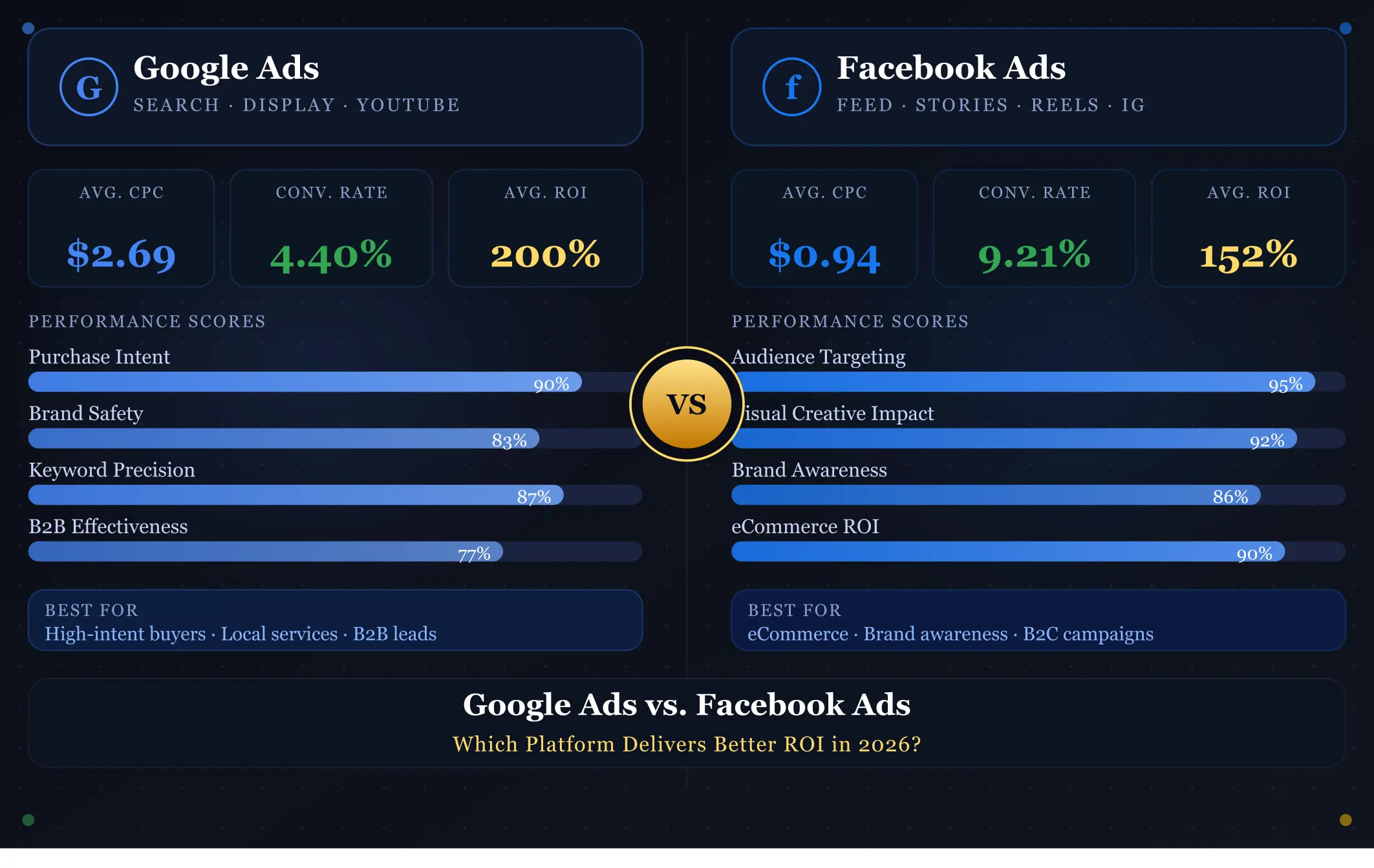
Winner: Tie – Google wins for intent-based targeting; Facebook wins for granular demographic and interest targeting.
Cost and Budget Efficiency
Google Ads Average Costs (2026):
• Average CPC (Cost Per Click): $2-$4 across all industries
• Competitive industries: $6-$50+ per click (legal, insurance, finance)
• Display Network: $0.50-$2 per click
• YouTube Ads: $0.10-$0.30 per view
Facebook Ads Average Costs (2026):
• Average CPC: $0.50-$2.00
• Average CPM (Cost Per 1,000 Impressions): $7-$15
• Instagram Ads: Typically 20-30% higher than Facebook
• Video ads: $0.01-$0.05 per view
Winner: Facebook Ads – Generally lower cost per click and impression, making it more budget-friendly for small businesses and awareness campaigns.
Important note: Lower cost doesn’t always mean better ROI. A $10 click that converts is more valuable than 20 $0.50 clicks that don’t.
Conversion Rates and Sales Performance
Google Ads Conversion Rates:
• Search Ads average: 3.75% across all industries
• Top performers: 5-10%+ (e-commerce, professional services)
• Display Ads: 0.77% average
• Shopping Ads: 1.91% average
Facebook Ads Conversion Rates:
• Average across all industries: 9.21% (but this includes engagement, not just purchases)
• E-commerce conversion rate: 1-2%
• Lead generation: 10-15%
• App installs: 15-20%
Winner: Google Ads – Higher purchase intent typically leads to better conversion rates for direct sales, especially in e-commerce and B2B.
Ad Formats and Creative Options
Google Ads Formats:
• Search Ads: Text-based ads in search results
• Display Ads: Banner ads across 2+ million websites
• Shopping Ads: Product images with prices in search results
• Video Ads: YouTube pre-roll, mid-roll, and discovery ads
• App Promotion Ads: Drive app downloads
• Performance Max: AI-powered campaigns across all Google properties
Facebook Ads Formats:
• Image Ads: Single image posts
• Video Ads: Short-form and long-form video content
• Carousel Ads: Multiple scrollable images or videos
• Collection Ads: Immersive mobile shopping experiences
• Stories Ads: Full-screen vertical ads on Facebook and Instagram Stories
• Messenger Ads: Direct conversations with potential customers
• Reels Ads: Short-form video ads on Instagram and Facebook Reels
Winner: Facebook Ads – More creative flexibility and visually engaging formats, especially for brand storytelling and mobile-first experiences.
Best Use Cases by Business Type
When Google Ads Performs Best:
✅ E-commerce with high-intent products
• Example: “Buy iPhone 15 Pro Max” – user ready to purchase
✅ Local services with urgent needs
• Example: “Emergency plumber near me” – immediate need
✅ B2B with specific solutions
• Example: “Enterprise CRM software” – researching specific tools
✅ High-ticket items with research phase
• Example: “Best luxury SUVs 2026” – comparison shopping
✅ Seasonal or event-driven products
• Example: “Valentine’s Day flowers delivery” – time-sensitive
When Facebook Ads Performs Best:
✅ Brand awareness and discovery
• Introducing new products or services to cold audiences
✅ Impulse purchases and lifestyle products
• Fashion, accessories, home decor, beauty products
✅ Visual products that tell a story
• Travel, food, fitness, lifestyle brands
✅ Community-building and engagement
• Building loyal audiences through content and interaction
✅ Lead generation with nurturing
• Capturing leads for longer sales cycles (real estate, coaching, courses)
✅ Retargeting and remarketing
• Re-engaging website visitors who didn’t convert
Winner: Depends on your business model – Neither platform is universally better; success depends on matching the platform to your specific goals.
Learning Curve and Ease of Use
Google Ads Complexity:
• Steeper learning curve: Keyword research, match types, Quality Score, bidding strategies
• More technical: Requires understanding of search intent and keyword optimization
• Campaign structure: Ad groups, keywords, negative keywords, extensions
• Time to proficiency: 3-6 months for beginners
Facebook Ads Complexity:
• More intuitive interface: Visual campaign builder, easier to get started
• Creative-focused: Emphasis on images, videos, and ad copy
• Audience testing: Requires experimentation to find winning audiences
• Time to proficiency: 1-3 months for beginners
Winner: Facebook Ads – Easier for beginners to launch campaigns and see initial results, though mastery still requires experience.
Tracking and Analytics
Google Ads Tracking:
• Google Analytics 4 integration: Comprehensive user journey tracking
• Conversion tracking: Detailed attribution across devices and touchpoints
• Search term reports: See exactly what users searched before clicking
• Auction insights: Compare performance against competitors
Facebook Ads Tracking:
• Meta Pixel: Track website actions and build custom audiences
• Conversions API: Server-side tracking for improved accuracy (post-iOS 14 privacy changes)
• Attribution windows: 1-day, 7-day, or 28-day click/view attribution
• Breakdown reports: Analyze performance by age, gender, placement, device
Winner: Google Ads – More robust tracking and attribution, especially for multi-touch customer journeys.
Important: Both platforms have been impacted by privacy changes (iOS 14+, cookie deprecation), making first-party data increasingly important.
Real-World ROI Comparison: Case Studies
Case Study 1: E-commerce Fashion Brand
Business: Online clothing retailer, $50 average order value
Google Ads Results (3 months):
• Spend: $15,000
• Clicks: 5,000
• Conversions: 200
• Revenue: $10,000
• ROI: -33% (loss)
Facebook Ads Results (3 months):
• Spend: $15,000
• Clicks: 30,000
• Conversions: 450
• Revenue: $22,500
• ROI: +50% (profit)
Winner: Facebook Ads – Visual products with impulse-buy potential performed better on a platform designed for discovery and browsing.
Case Study 2: B2B SaaS Company
Business: Project management software, $99/month subscription
Google Ads Results (3 months):
• Spend: $20,000
• Clicks: 4,000
• Free trial signups: 320
• Paid conversions: 64
• Revenue (annual): $76,032
• ROI: +280%
Facebook Ads Results (3 months):
• Spend: $20,000
• Clicks: 40,000
• Free trial signups: 800
• Paid conversions: 40
• Revenue (annual): $47,520
• ROI: +138%
Winner: Google Ads – High-intent searches from users actively looking for solutions led to better-qualified leads and higher conversion rates.
Case Study 3: Local Service Business (Plumbing)
Business: Emergency plumbing services, $300 average job value
Google Ads Results (3 months):
• Spend: $6,000
• Clicks: 1,200
• Phone calls: 180
• Booked jobs: 90
• Revenue: $27,000
• ROI: +350%
Facebook Ads Results (3 months):
• Spend: $6,000
• Clicks: 12,000
• Phone calls: 60
• Booked jobs: 30
• Revenue: $9,000
• ROI: +50%
Winner: Google Ads – Local, urgent services benefit from search intent; people don’t browse Facebook looking for plumbers.
The Hybrid Approach: Using Both Platforms Together
The most successful advertisers don’t choose one platform—they use both strategically:
Full-Funnel Strategy:
Top of Funnel (Awareness):
• Facebook Ads: Introduce your brand to cold audiences
• Goal: Build awareness, educate, create interest
• Metrics: Reach, impressions, engagement, video views
Middle of Funnel (Consideration):
• Facebook Retargeting: Re-engage website visitors with social proof, testimonials, offers
• Google Display Ads: Remind users across the web
• Goal: Nurture interest, build trust, overcome objections
• Metrics: Click-through rate, time on site, content engagement
Bottom of Funnel (Conversion):
• Google Search Ads: Capture high-intent searches
• Facebook Retargeting: Final push with limited-time offers
• Goal: Drive conversions and sales
• Metrics: Conversion rate, cost per acquisition, ROI
Example Integrated Campaign:
Month 1-2: Run Facebook Ads to build awareness and collect website visitors (install Meta Pixel)
Month 2-3: Launch Google Search Ads targeting high-intent keywords + Facebook retargeting ads to website visitors
Month 3+: Optimize both platforms based on performance data, scale winners, pause losers
Result: Lower overall customer acquisition cost by combining awareness (Facebook) with intent capture (Google).
How to Decide Which Platform is Right for You
Ask yourself these questions:
Choose Google Ads if:
✅ Your customers actively search for your product/service
✅ You offer urgent or time-sensitive solutions
✅ You have a clear keyword strategy
✅ You’re in a high-intent industry (legal, medical, B2B, local services)
✅ You want to capture existing demand
✅ You have a higher budget per click
Choose Facebook Ads if:
✅ Your product is visually appealing
✅ You’re building brand awareness
✅ You sell impulse-buy or lifestyle products
✅ You have strong creative assets (images, videos)
✅ You want to test new markets or audiences
✅ You have a limited budget and need volume
✅ You’re targeting specific demographics or interests
Use Both Platforms if:
✅ You have a sufficient budget ($2,000+/month)
✅ You want to dominate your market
✅ You need both awareness and conversion
✅ You’re running a full-funnel marketing strategy
✅ You want to maximize reach and frequency
2026 Trends Affecting Both Platforms
AI and Automation
Both platforms are heavily investing in AI:
• Google Performance Max: Automated campaigns across all Google properties
• Meta Advantage+: AI-powered campaign optimization
Impact: Less manual control, but better performance for those who provide quality creative and data.
Privacy and Tracking Changes
iOS privacy updates and cookie deprecation continue to impact tracking:
• First-party data is king: Build email lists and customer databases
• Server-side tracking: Implement Conversions API (Facebook) and enhanced conversions (Google)
• Broader targeting: AI compensates for reduced granular tracking
Video-First Content
Both platforms prioritize video:
• YouTube Shorts (Google) and Reels (Facebook/Instagram) dominate engagement
• Video ads consistently outperform static images
E-commerce Integration
Seamless shopping experiences:
• Google Shopping Graph: Enhanced product discovery
• Facebook Shops: In-app purchasing without leaving the platform
Maximizing ROI: Best Practices for Each Platform
Google Ads Best Practices:
Focus on Quality Score: Better ad relevance = lower costs
Use negative keywords: Prevent wasted spend on irrelevant searches
Leverage ad extensions: Sitelinks, callouts, structured snippets increase CTR
Optimize landing pages: Match ad message to landing page for better conversions
Test responsive search ads: Let Google’s AI find winning combinations
Bid on branded keywords: Protect your brand from competitors
Facebook Ads Best Practices:
Test multiple creatives: Run 3-5 ad variations per campaign
Use video content: Video ads typically outperform static images
Leverage lookalike audiences: Find new customers similar to your best existing ones
Retarget strategically: Segment audiences by engagement level
Optimize for mobile: 90%+ of Facebook users access via mobile
Use social proof: Include testimonials, reviews, user-generated content
Common Mistakes to Avoid
Google Ads Mistakes:
❌ Broad match keywords without negatives: Wastes budget on irrelevant clicks
❌ Ignoring Quality Score: Leads to higher costs and lower ad positions
❌ Poor landing page experience: High bounce rates hurt performance
❌ Not using ad extensions: Misses opportunities to increase CTR
❌ Setting and forgetting: Requires ongoing optimization
Facebook Ads Mistakes:
❌ Targeting too narrowly: Limits reach and increases costs
❌ Weak creative: Boring ads get ignored in crowded feeds
❌ Not testing audiences: One audience rarely works for everyone
❌ Ignoring mobile optimization: Most users are on mobile devices
❌ Overlooking retargeting: Leaving money on the table
Conclusion: Which Platform Delivers Better ROI?
The answer isn’t black and white. Here’s the truth:
Google Ads typically delivers better ROI for:
• High-intent purchases
• Local and urgent services
• B2B and complex sales
• Established brands capturing existing demand
Facebook Ads typically delivers better ROI for:
• Brand awareness and discovery
• Visual and lifestyle products
• Impulse purchases
• Building audiences for long-term nurturing
The best ROI comes from using both platforms strategically, leveraging Facebook for awareness and audience building, then capturing that demand with Google Search Ads when users are ready to buy.
Your action plan:
Start with your business goals: Awareness, leads, or direct sales?
Analyze your customer journey: Where do they discover and research?
Test both platforms with small budgets ($500-$1,000 each)
Measure actual ROI, not just clicks or impressions
Scale what works, pause what doesn’t
Integrate both platforms for maximum impact
Need help choosing the right advertising strategy for your business? At DigitalBodh, we’ve managed millions in ad spend across Google and Facebook, delivering measurable ROI for businesses of all sizes. With nearly 15 years of performance marketing experience, we know how to maximize every advertising dollar.
Get a free advertising audit and discover which platform—or combination—will drive the best results for your business.
Latest Posts




Categories
- AI in Business
- AI Insights
- App Spotlight
- Apps & Software
- Artificial Intelligence
- Breakthroughs & Beyond
- Business & Startups
- Culture & Compass
- Disruptive Models
- Future of Intelligence
- Global Getaways
- Innovation Hub
- Lab to Life
- Misc
- Offbeat Adventures
- Performance & Modifications
- Productivity Picks
- Safe & Secure
- Science & Innovation
- Smart Systems
- Software Showcase
- Software Showcase
- Startup Stories
- Tech Meets Nature
- Tech Trends
- Technology
- Travel
- Travel & Tourism
- UX & UI Trends
Tags
5G eSIM Spain 2025 2026 activate Dubai eSIM Additional bond cleaning services Melbourne affordable smart home affordable travel connectivity aitools bestplacestovisit best time to visit japan Bubble Planet Sydney commbitzesim Data-driven test automation data roaming tips digital SIM Dubai Dubai eSIM guide ecommerce effortless travel Enterprise SEO Agency esim family activities Wisconsin Dells Fashion game development guide Health international data plans internationalesim japan Laser Dentistry: The Future of Painless and Precise Dental Care musthaveguide office interior designer in Gurgaon Organic SEO agency services overseas education opportunities SEO traffic growth strategy stress-free life after 40 Tech Technology Travel travel advice travel essentials travel smarter travel technology Europe vegan food apps white label SEO yosemite national park