
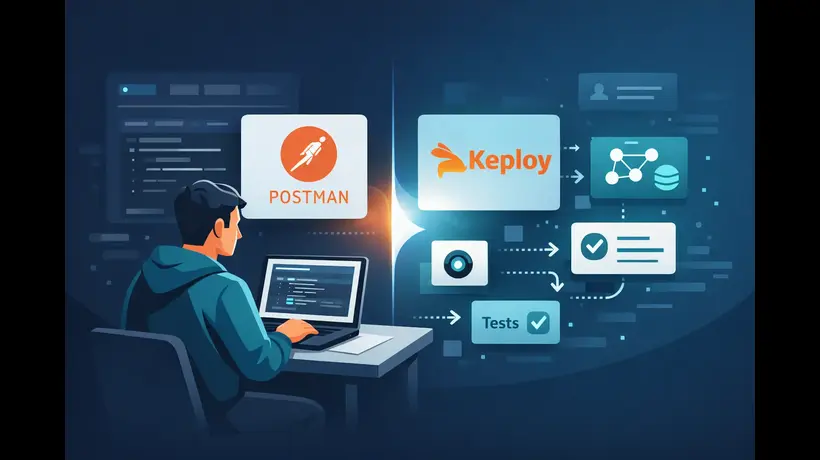
API testing has become a non-negotiable part of modern software development. As teams scale and release cycles get faster, choosing the right testing tool can make a significant difference in how efficiently you ship reliable software. Two names that come up frequently in this space are Keploy and Postman — but they serve very different purposes, and understanding that distinction is key.
Postman has been the go-to tool for API development and manual testing for years. It offers a clean interface for sending requests, inspecting responses, and building collections of API tests. Developers love it for exploring APIs, debugging endpoints, and collaborating on API documentation. However, Postman still relies heavily on manually written test scripts, which means your test coverage is only as good as the time your team puts into writing and maintaining those scripts.
Keploy takes a fundamentally different approach. Instead of requiring developers to write test cases from scratch, Keploy automatically captures real API traffic and converts it into test cases and data mocks. This means your tests are generated from actual production or development behavior, making them inherently more realistic and reducing the manual effort involved in building a regression suite.
The core difference comes down to this: Postman is a developer-first API client that supports testing, while Keploy is an automated testing platform built specifically to eliminate the burden of test authoring. With Keploy, every API call your application makes can become a test — without writing a single line of test code.
For teams practicing CI/CD, Keploy integrates directly into pipelines and runs recorded tests automatically on every build. Postman also supports CI integration through Newman, its command-line runner, but teams still need to maintain the underlying test collections manually.
Another area where Keploy stands out is data mocking. When Keploy records API interactions, it also captures the downstream dependencies — database calls, third-party services, and internal microservices — and mocks them automatically. This makes tests fast, isolated, and repeatable without needing a full live environment.
Postman does support mock servers, but setting them up requires manual configuration and ongoing maintenance as your APIs evolve.
From a cost and scalability perspective, Keploy is open-source at its core, which makes it an attractive option for startups and engineering teams that want powerful automated testing without heavy licensing costs. Postman offers a free tier but charges for advanced collaboration and automation features at scale.
So which one should you choose? If your team needs a tool for API exploration, documentation, and manually curated test collections, Postman remains a solid choice. But if your goal is to maximize automated test coverage with minimal developer effort — especially for backend APIs and microservices — Keploy offers a more scalable, modern approach.
You can explore the full comparison and see how the two tools stack up across key parameters here: Keploy vs Postman
The bottom line is that the two tools are not direct competitors in every sense — but for teams serious about automated API testing at scale, Keploy is worth a close look.